Telehealth brands rarely struggle because they lack marketing activity. Campaigns are live. Channels are running. Content is being published. Agencies are testing new angles. Dashboards show movement. On the surface, it looks like progress.
But underneath that activity, something usually feels off. Lead quality is inconsistent. Conversion rates fluctuate without a clear explanation. Retention does not match acquisition effort. Teams keep adding tactics, but growth remains unpredictable. It becomes noisier.
That is the core issue. Many telehealth companies are not missing tactics. They are missing an online marketing strategy that connects those tactics into a system. Without that structure, marketing becomes a collection of experiments rather than a reliable growth engine.
In telehealth, that gap is more expensive than it looks. Every acquisition decision affects trust, onboarding, retention, and long-term value. That means disconnected marketing does not just waste budget. It creates instability across the entire business.
If your telehealth growth depends on “trying more tactics,” the problem isn’t tactics. It’s the system.
Key Takeaways
- An online marketing strategy in telehealth is a system, not a list of tactics.
- Disconnected tactics often increase activity but weaken the quality of growth.
- Channel performance should be evaluated by downstream outcomes, not just front-end metrics.
- Messaging, funnel design, and channel roles must work together to support trust and conversion.
- Privacy-aware measurement is essential, especially when handling sensitive user journeys.
- Strong telehealth growth comes from coordination, not channel expansion.
What an Online Marketing Strategy Means in Telehealth
An online marketing strategy defines how a business attracts, qualifies, converts, and retains users through digital channels. In telehealth, that definition needs more discipline than usual.
It is not enough to run SEO, paid search, paid social, and email campaigns independently. Each of those channels influences how users understand the product, what expectations they bring into the funnel, and whether they move forward with confidence. If those channels operate without coordination, the business starts creating mixed signals.
This is where the difference between tactics and systems becomes clear. Tactics are individual actions. Systems define how those actions connect and reinforce each other. A telehealth brand with strong tactics but weak coordination often looks busy but performs inconsistently.
Telehealth brands cannot rely on isolated wins. A strong campaign in one channel cannot compensate for weak messaging, unclear onboarding, or inconsistent expectations across the journey. When the system is misaligned, even high-performing tactics produce unstable results.
Why Random Online Marketing Tactics Fail in Telehealth
Random tactics often create visible activity. They generate clicks, leads, and short-term engagement. That activity can appear to be growth, especially when viewed through platform dashboards.
The problem is that activity does not guarantee quality.
When tactics are disconnected, each channel starts optimizing for its own version of success. Paid social may prioritize volume. Search may prioritize intent capture. Content may prioritize traffic. Email may prioritize engagement. None of those is wrong on its own, but without coordination, they pull the system in different directions.
Weak coordination creates trust and conversion problems. A user who sees one message in an ad, a different message on a landing page, and a third message during onboarding enters the funnel with confusion. That confusion lowers conversion quality, even if initial engagement looks strong.
Front-end performance can hide downstream weakness. A campaign may generate low-cost leads, but if those leads do not convert or retain well, the business is not actually improving. It is simply moving inefficiency further down the funnel.
Privacy-aware measurement adds another layer of complexity. Telehealth brands must be careful about how they design tracking, audience logic, and attribution systems. A strong strategy does not require aggressive data collection. It requires clarity on which signals actually matter and how to use them responsibly.
The Core Components of a Strong Online Marketing Strategy
A strong online marketing strategy in telehealth depends on alignment across a few key areas. When one breaks, performance becomes inconsistent.
- Clear positioning and audience fit: The strategy must attract the right users, not just the largest possible audience. Weak positioning leads to weak-fit demand.
- Defined channel roles: SEO, paid search, paid social, email, and content each serve different purposes. Treating them the same creates inefficiency.
- Consistent messaging across the journey: Users should not need to reinterpret the product at every step. Clarity improves conversion quality.
- Funnel design that supports qualification: Landing pages should not only capture interest. They should set expectations and reduce confusion.
- Measurement tied to business outcomes: Performance should be evaluated based on conversion quality, retention, and long-term value, not just front-end metrics.
These components are not independent. They reinforce each other. When aligned, they create a system that yields more stable, predictable growth.
How Telehealth Brands Turn Tactics Into a Real Growth System
Turning tactics into a system requires connecting decisions across the full user journey.
Acquisition cannot be separated from onboarding and retention. The type of users a channel attracts affects how easily they move forward and how long they stay engaged. If acquisition brings in poorly aligned users, no amount of optimization later in the funnel will fully correct that.
Content and paid channels should work together rather than compete for credit. Content builds understanding and trust. Paid channels accelerate discovery and capture intent. When aligned, they improve both efficiency and quality.
Feedback loops are critical. Marketing should not operate as a one-way process where campaigns are launched and evaluated only on platform metrics. Instead, insights from conversion quality, onboarding behavior, and retention should influence how channels are managed.
Better coordination improves efficiency without requiring constant expansion. Many telehealth brands try to solve growth problems by adding more channels. In reality, improving the connection between existing channels often delivers stronger results.
Common Online Marketing Strategy Mistakes in Telehealth
Some patterns show up repeatedly when telehealth marketing lacks structure:
- Launching channels without defining their role: Every channel is expected to do everything, which usually leads to confusion.
- Letting each touchpoint create different expectations: Messaging inconsistency reduces trust and conversion quality.
- Scaling what looks efficient without validating quality: Low-cost leads can still be low-value leads.
- Adding more tracking instead of improving strategy: More data does not fix weak positioning or unclear funnels.
- Confusing activity with progress: More campaigns do not automatically mean better outcomes.
These mistakes are common because they often produce short-term wins. The downside appears later, when the business tries to scale and discovers that the system is unstable.
Why Telehealth Growth Needs More Than Campaign Execution
Telehealth growth is not just a marketing problem. It is a system problem that connects marketing, analytics, operations, and retention.
Campaign execution alone cannot solve structural issues. If the strategy behind those campaigns is unclear, performance will remain inconsistent. Teams may spend more, test more, and optimize more, yet still fail to achieve stability.
Growth requires system-level discipline. That means defining how channels work together, how messaging flows across the journey, and how performance is evaluated beyond surface-level metrics.
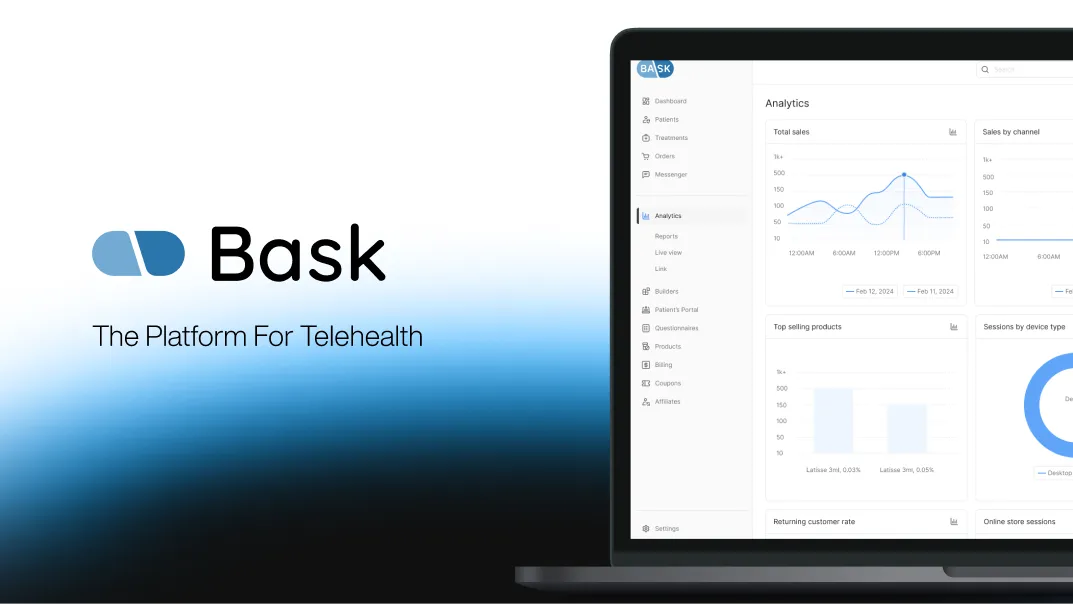
This is where platforms like Bask Health fit naturally into the conversation. Not as a shortcut, but as a way to support more structured decision-making. When telehealth brands start asking better questions about acquisition quality, funnel alignment, and measurement clarity, they move from reactive marketing to intentional growth.
How to Improve an Online Marketing Strategy Right Now
Improvement starts with understanding how the current system behaves.
First, audit existing tactics based on their real role in the funnel. Which channels create awareness? Which captures intent? Which supports conversion? Which improves retention? If those roles are unclear, the strategy needs refinement.
Next, identify where the system is disconnected. Look for gaps between messaging, landing pages, and follow-up communication. These gaps often explain why performance feels inconsistent.
Simplify reporting around useful signals. Telehealth brands should prioritize clarity over complexity, especially when working within privacy-aware constraints. Focus on metrics that reflect real progress, not just platform activity.
Finally, fix one broken connection before adding new tactics. Growth improves faster when the existing system becomes stronger, not when it becomes more crowded.
Conclusion
Telehealth brands do not build durable growth by stacking random tactics until something works. They build it by creating an online marketing strategy that connects those tactics into a coherent system.
When messaging is aligned, channels have clear roles, and performance is measured against real outcomes, marketing becomes more than activity. It becomes a reliable part of the business.
That is the difference between growth that looks good on a dashboard and growth that actually holds up over time.
References
- National Institute of Standards and Technology. (n.d.). Privacy Framework. U.S. Department of Commerce. https://www.nist.gov/privacy-framework
- U.S. Department of Health & Human Services, Office for Civil Rights. (2024, June 26). Use of online tracking technologies by HIPAA-covered entities and business associates. U.S. Department of Health & Human Services. https://www.hhs.gov/hipaa/for-professionals/privacy/guidance/hipaa-online-tracking/index.html
- Federal Trade Commission. (2024, August). Collecting, using, or sharing consumer health information? Look to HIPAA, the FTC Act, and the Health Breach Notification Rule. U.S. Federal Trade Commission. https://www.ftc.gov/business-guidance/resources/collecting-using-or-sharing-consumer-health-information-look-hipaa-ftc-act-health-breach
- Centers for Disease Control and Prevention. (2024, October 16). Understanding health literacy. U.S. Department of Health & Human Services, Centers for Disease Control and Prevention. https://www.cdc.gov/health-literacy/php/about/understanding.html